
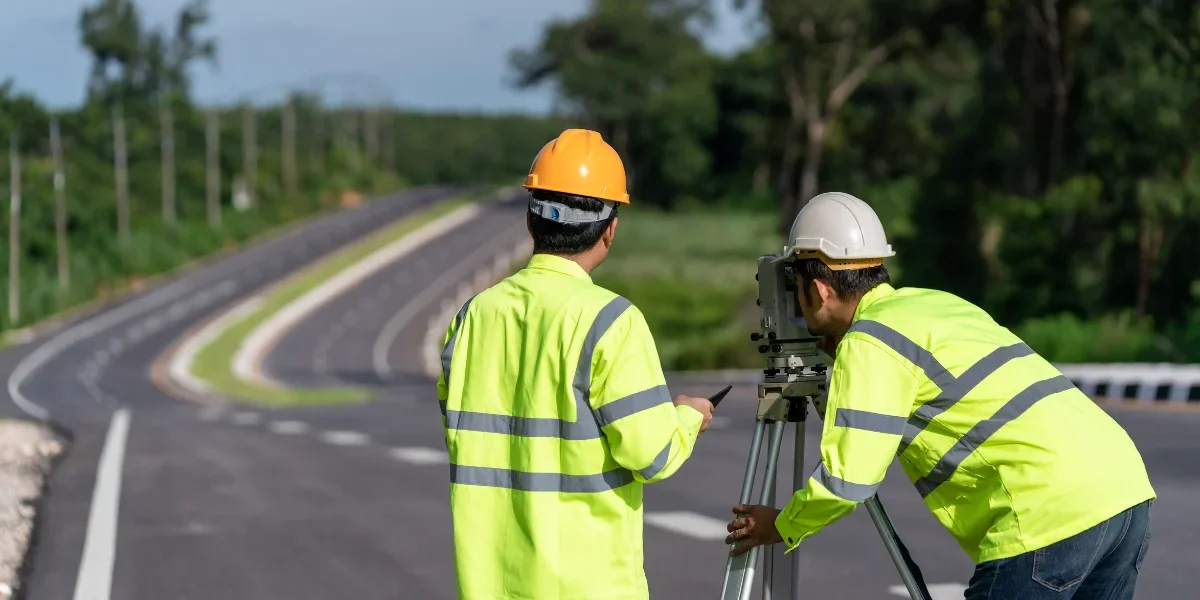
Road development projects involve many moving parts, and survey issues can create problems at almost any stage. An unclear boundary or incomplete topographic data can slow design work, complicate approvals, and create avoidable construction setbacks.
Land surveying is involved across multiple stages of road development. In this blog, we break down the typical survey requirements at each stage and why they matter.
Note: Survey requirements and processes may vary depending on project scope, site conditions, site constraints, and municipal regulations. Some road development projects may require additional survey work or a different sequence of deliverables based on complexity and location.
Here’s how a land surveyor plays a role at each stage of a road development project:
1. Pre-Planning and Feasibility Stage
At the earliest stage, survey work focuses on understanding the land before any design decisions take shape. This step supports feasibility studies, route selection, and high-level planning.
Survey requirements at this stage may include:
- Boundary surveys
Establish legal property limits and identify adjacent ownership. Team AGG focuses on evaluating right-of-way requirements and land acquisition needs. - Existing conditions survey
Capture visible features such as roads, fences, utilities, drainage paths, and natural elements. This provides a baseline for planners and engineers. - Topographic mapping
Identify elevation changes, slopes, and terrain conditions that form the foundation for road alignment and initial grading concepts. - Utility locates and mapping
Record visible and known underground utilities to avoid conflicts in early planning.
Project teams need reliable data to decide whether the proposed road alignment makes sense from a technical and regulatory standpoint.
2. Preliminary Design Stage
Survey data in this stage supports alignment planning, environmental review, and coordination with consultants.
Survey requirements at this stage may include:
- Detailed topographic survey
Provide dense elevation data across the corridor. Engineers use this to design road profiles, drainage systems, and cross sections. - Control surveys
Establish horizontal and vertical control points that serve as reference for all future survey and construction work. - Right-of-way surveys
Define existing road allowances and identify land required for expansion or new road corridors. - Environmental and feature mapping
Locate trees, water bodies, and environmentally sensitive areas that may impact approvals. - Preliminary alignment staking (if required)
Mark proposed road centerlines on site to validate design assumptions.
Surveyors must coordinate closely with engineers, planners, and environmental consultants during this phase.
3. Detailed Design and Engineering Stage
At this stage, engineers finalize road geometry, grading, and infrastructure details. Survey requirements must meet a higher level of accuracy.
Survey requirements at this stage may include:
- High-resolution topographic data
Provide refined elevation models to support final grading plans and drainage design. - Legal surveys and reference plans
Prepare documentation for land acquisition, easements, and road widening that complies with Ontario land registry requirements. - Construction layout preparation
Convert design drawings into coordinates and points that can be used on site. - Utility survey verification
Confirm existing utility locations and identify potential conflicts with proposed infrastructure. - Digital terrain models (DTMs)
Support design validation and quantity calculations for cut and fill.

4. Pre-Construction and Staking Stage
Before construction begins, surveyors translate design into physical points on the ground.
Survey requirements at this stage may include:
- Construction staking and layout
Mark road centerlines, edges, grades, and key infrastructure elements such as culverts and intersections. - Benchmark establishment
Set elevation reference points that guide grading and construction activities. - Machine control data preparation
Provide digital files that integrate with GPS-guided equipment used by contractors. - Verification of site conditions
Confirm that actual site conditions match design assumptions before work begins.
5. Construction Stage
During construction, surveyors remain actively involved to monitor progress and maintain accuracy. This stage focuses on verification and adjustment.
Survey requirements at this stage may include:
- As-built verification during construction
Check installed elements such as road base, drainage systems, and utilities against design specifications. - Grade checks and adjustments
Ensure grading aligns with approved plans to prevent drainage issues or structural concerns. - Progress surveys
Support quantity tracking for materials such as excavation and fill. - Issue identification
Detect deviations early and provide corrected layout where needed.
Surveyors act as a control mechanism during construction and ensure that errors do not compound as the project progresses.
6. Post-Construction and As-Built Stage
Once construction is complete, final survey documentation confirms that the road has been built according to approved plans.
Survey requirements at this stage may include:
- As-built surveys
Record the final position and elevation of all constructed elements. These drawings are required for municipal acceptance. - Compliance verification
Confirm that the project meets regulatory and design requirements. - Final reference plans (R-Plans)
Register legal boundaries and road widenings in the land registry system. - Data for asset management
Provide municipalities with accurate records for future maintenance and upgrades.
This stage closes the loop. It ensures that all stakeholders, including municipalities, have a clear and accurate record of what was built.
Choosing the Right Land Surveyor for Road Projects in Kingston and Sudbury
Road development demands consistency across multiple phases, often over extended timelines. A survey partner must provide more than isolated deliverables.
As your land survey partner, we:
- Understand infrastructure and municipal requirements in Ontario
- Maintain consistent data standards across all project stages
- Uses modern surveying technology for accuracy and efficiency
- Communicate clearly with engineers, contractors, and planners
If you are planning a road development project in Ontario, Avant Garde Geomatics can support your team with accurate survey data at every stage. Reach out today to discuss your project scope and book a consultation.